
By Kevin Brown
The Turned Page
Days of Dissent, Gabriel San Roman’s second book (following Victor Jara and the New Chilean Song Movement) offers 365 short vignettes – one for every day of the year – about the ways people throughout the world, and throughout history, have pushed back against repression, exploitation, and racial, gender, and class bigotry.
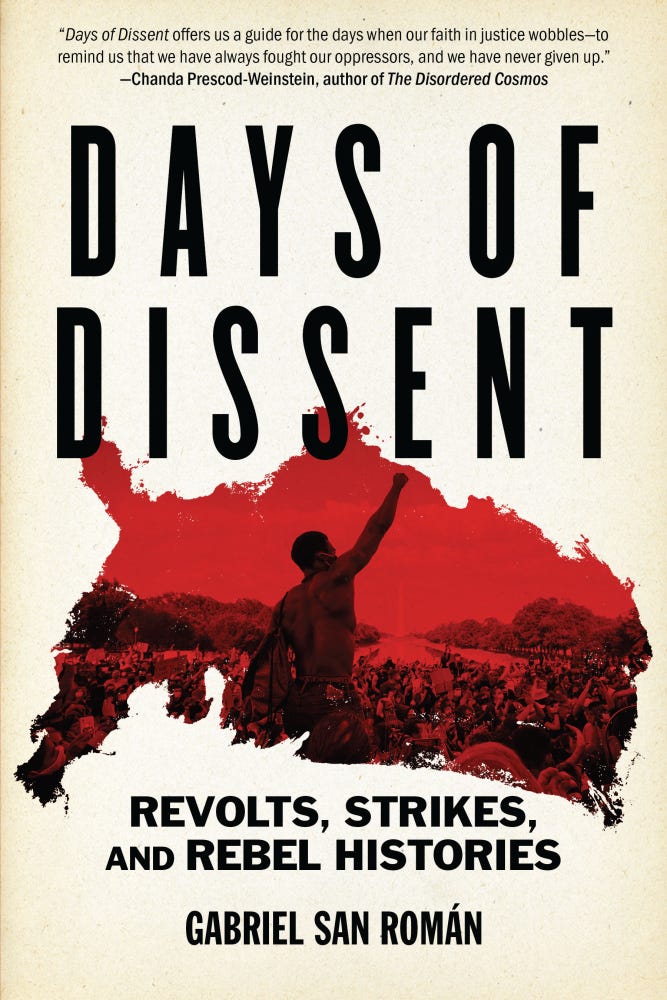
The book is an engaging read, filled with anecdotal nuggets that remind readers that dire political moments, police violence, and right-wing pushback have been throughlines in every era. At the same time, the book provides ample evidence of the equally strong human impulse to organize against intolerable conditions in the workplace, in communities, and when promulgated through unfair social policies.
Some of the events San Roman includes are well known (Emmett Till’s brutal 1955 killing; the lunch counter sit-ins that began in 1960; the1969 Stonewall Riot; the 1980 murder of four nuns in El Salvador; the Bhopal chemical explosion in 1984) but many are not and his focus on people of color, indigenous communities, and those disenfranchised by racism, sexism, homophobia, transphobia, and economic inequities make it an excellent resource.
Entries include both positive and negative incidents.
For example, an entry for February 22, 1898, chronicles the brutal death of postmaster Frazier B. Baker, the first Black postmaster in Lake City, South Carolina. Baker was killed in an arson attack that burned his home to the ground with him in it, and San Roman notes that eleven men eventually faced trial for Baker’s murder. But justice was not served: San Roman reports that after the jury deadlocked, the eleven were freed.
On a happier note, an entry for August 25, 1925, reports that on that day, A. Philip Randolph became the leader of the Brotherhood of Sleeping Car Porters. Randolph was a militant labor leader and he and his coworkers pressured the railway bosses to grant a charter to the union. It was the first time, San Roman writes, that a white owner was “forced to come to terms with a Black union.”
Day of Dissent showcases a slew of other labor victories as well. Among the most surprising was a strike called by the Workingmen’s Amalgamated Council which was made up of three racially-integrated New Orleans unions – the Teamsters, the Scalemen, and the Packers. The strike began on November 8, 1892. The demands? A shorter workday, overtime pay, and closed shops.
“The employers appealed to racism, hoping to divide workers and the city at large, but the solidarity of the strike couldn’t be broken,” San Roman writes. In fact, a general citywide strike followed, with 25,000 workers walking off the job. Despite horrific pushback by the City’s elite, the workers eventually prevailed, winning a 10-hour day and overtime pay and proving that Black and white workers could organize together – even in the American South.
All told, Days of Dissent provides a kaleidoscopic introduction to the ups-and-down endemic to movements for social change. And while I wished the book had included more examples of international feminist agitation, the 365 day framework limits what could be included in this valuable work.
As San Roman writes in his Introduction, the book is not intended to be a comprehensive world history of resistance. Instead, he says it “casts a wide net over working-class, ethnic, feminist, and queer histories spanning centuries, mostly within the United States but also beyond its borders…[It] speaks to a pestilent racism and xenophobia that continues to hamper the historical potential of the working class to this day.”