By Ian Allinson
rs21
September 7th, 2026
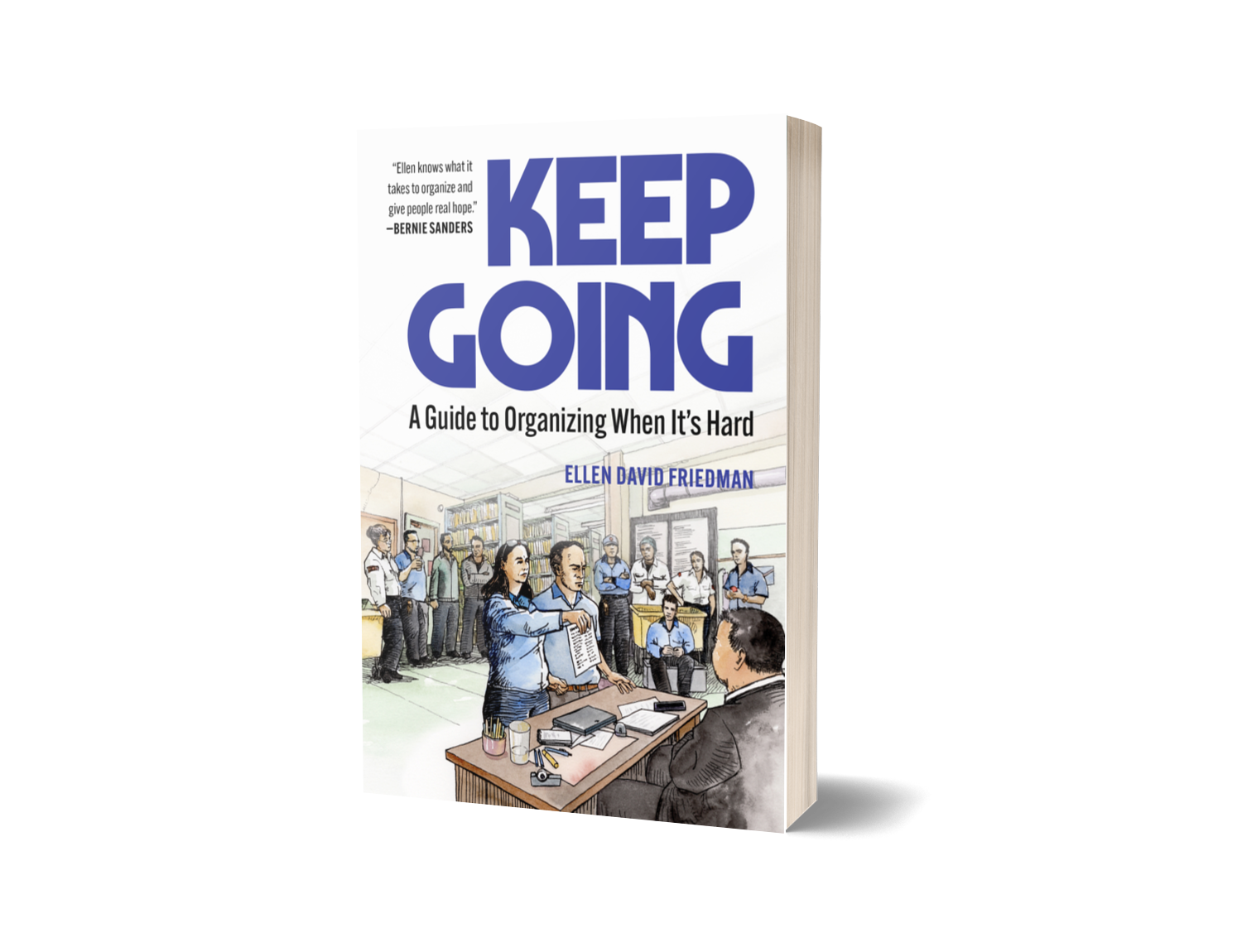
Activist and author Ian Allinson recommends the latest book from Labor Notes. Author Ellen David Friedman has packed it full of good advice for organising at work and elsewhere.
Ellen David Friedman will be speaking at an online book launch hosted by rs21 at 7pm (British time) on Tuesday 29 September. Details and registration are at revsoc21.uk/meet.
Keep Going doesn’t teach you organising methods and techniques. Instead, it focuses on the attitudes to cultivate (and avoid) when you are trying to build resistance or a union. Broken into sections of 1-3 pages, the book shows how democracy; curiosity; prioritising relationships; building trust and respect; and a focus on expanding workers’ collective power make a practical difference in many different ways. In part the book is able to skip techniques because that is the focus of another Labor Notes book: Secrets of a Successful Organizer.
The book draws on real-life examples, going deeper than most guides into how to do things. Rather than just encouraging you to start conversations with colleagues, it provides examples of good questions to ask. Rather than just telling you to communicate widely about wins in cases for individual members, it gives examples of worst, better and best newsletter articles. Rather than just telling you to use collective power rather than relying on formal grievance procedures, it gives an example of how an issue might develop with both methods.
Parts III and IV, nearly half the book, are devoted to ‘getting unstuck’ and encouraging you to ‘think again’ about common ways unions operate. ‘Getting unstuck’ has sections on everything from apathy to high staff turnover and burnout. ‘Think again’ includes sections on selling the union, cheerleading, constant urgency, confidentiality and much more. Even where I think the critique goes too far, for example in its rejection of the use of anger to motivate people to action, it is a valuable counterbalance to a crude and manipulative approach.
The latter parts of the book are valuable reading for any activist, not just those trying to organise at work, because many of the problems they address are widespread in community organising, campaigns and social movements.
Friedman’s background is as a professional organiser rather than a worker activist, but puts a strong emphasis on workers’ self-activity rather than dependence on union staff, as you would expect from the board chair of the US-based activist network Labor Notes.
The book has been written for a US audience, so it refers to aspects of the industrial relations and legal system which are very different in Britain. However, because the main focus of the book is on attitudes rather than processes, this does little to reduce the value of the book for a British audience. Labor Notes’ decision to jointly publish the book with PM Press makes it easier to buy in Britain than some of their other titles.
I would heartily recommend this accessible book to anyone involved in trying to organise, particularly, but not exclusively, if your focus is the workplace.