
By Rob Jacobs
Originally published in Counterpunch
September 4th, 2026
Ishmael Reed understands the United States and its history better than most of its residents and certainly better than many of its politicians and the historians they read and listen to. Where Ken Burns and Broadway see an abolitionist named Alexander Hamilton and proceed to proffer him sainthood, Reed sees a slaveowner and slave trader who, like most of his fellow citizens, considered those humans of darker hued-skin were somehow less than those wearing skin they call white. His vision of the grand experiment in democracy comes from an understanding of how limited that democracy truly is. Similarly, he knows that the rulers of this nation have historically worked quite hard to keep it limited. A similar conception of American freedom informs his writing, be it poetry, essays or fiction. I’ve read much of what Mr. Reed has written—essays, biographies, plays and jazz music—but nothing ignites my senses and my intellect more than his fiction.
Recently, his 1976 novel titled Flight to Canada was republished to celebrate its fiftieth anniversary. Unlike so many other works of fiction situated in the history of the US’s enslavement of Africans and their descendants, this novel does not bring tears or involve pathos. Instead, it turns on a satire so clever it almost hides the savagery of the slaver inside a clownish burlesque. There’s a fugitive slave filming porn distributed by a Russian Jewish émigré, a filthy rich and ultra decadent slaveholding planter engaged in incest with this dead sister’s corpse, an Abe Lincoln portrayed as a white supremacist with a sense of the absurd, and a pirate whose fictional existence is the almost perfect representation for the phenomenon they say made America great the first time—unbridled and rapacious capitalism.
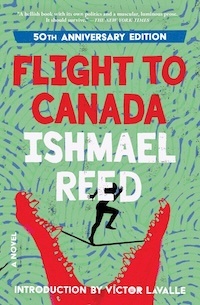
Not just about the slavery economy of the US South, its decadent plantation owners and the weaselly brutes they hire to catch those who escape their enslavement, Flight to Canada is also about the country they call America, its ruling class and their twisted imperialism. It’s also about their greed, lust, racism, and the means by which they express all of the above. To borrow from Victor Lavelle’s introduction, “this novel is a dressing down, a dismantling, a re-envisioning, done in a way few authors would attempt, even now, fifty years later.” (viii) Indeed. I would argue that such an attempt would be even less likely to be published today, when those who currently rule make what might once have been cause for shame now commonplace.
Two of the characters in Flight to Canada clearly represent the ruling class in the United States: the slaver Arthur Swille and Pirate Jack. Between the two characters one can find most every means by which the country we call the United States became the greed-soaked murdering empire it is today. Backhanded deals and straight-up robbery and murder; lies told so many times they’ve become the truth; blackmail and deceit. In other words, just like you and I know that history actually is. A few of the primary Black characters are the narrator Raven Quickskill, the hustler Leechfield who, like so many hustlers, fails to understand when he is being hustled, and Uncle Robin, a servant who ends up with Arthur Swille’s riches. If these characters sound more cartoonish than real, it’s because Reed’s pen tells a story whose tragedy is best expressed as farce, its curse as comedy. Absurdly profane and sharply profound, Flight to Canada deserves the nation’s attention, at least for those of us who still understand satire and its role in telling the truth.
The novel combines anachronism, modernity, history, and a truth greater than the facts, all wrapped up in a genre academics call the slave narrative. Laughing while reading it is as appropriate as nodding in knowing agreement. Reed’s question as to why “Edgar Allan Poe isn’t recognized as the principal biographer of that strange war” demands that I ask why Ishmael Reed isn’t recognized as a principal biographer of the last fifty years in this ever-strange, ever surprising nation. Perhaps the denial of these writers’ crucial roles lies in their understanding that this nation’s redemption is probably an impossibility not only because of its history, but also because of its refusal to make amends with those whose lives it so casually discarded and disregarded.
Ron Jacobs is the author of several books, including Daydream Sunset: Sixties Counterculture in the Seventies published by CounterPunch Books. His latest book, titled Reality, Resistance, Rock and Roll is a collection of book reviews written for Counterpunch over the years and is now available. He lives in Vermont. He can be reached at: [email protected]