By Peter Marshall
I have written two books on Cuba as I was interested in a socialist experiment which stood up against the USA and at first seemed independent. One was called Cuba Libre: Breaking the Chains? And with the photographer Barry Lewis, the second was called Into Cuba which involved travelling to different regions and discovering their cultures and traditions. In America, the first was published by Faber and the second by Van der Mark. Both received excellent reviews and were translated into several languages.
I put a question mark on the subtitle of the first book because I wanted to see how far the Cubans had really broken their chains after the revolution and whether they had achieved some sort of genuine freedom.
At first, it was a socialist revolution against the dictator Batista in the backyard of the USA. Che Guevara as head of the National Bank wanted to replace moral incentives for financial incentives, that is acting for the public good while all basic needs are met, and work, according to his pamphlet Socialism and Man, should be turned into ‘meaningful play’. He was unable to achieve these aims and became an international revolutionary travelling around Africa and South America.
Unable produce much oil itself, the Cuban government was forced to go into the arms of the Soviet Union in order to exchange oil for sugar on favourable terms. Fidel Castro now became the supreme chief and declared that he was a Marxist and tried to realise communism in the country. The ‘Bay of Pigs’ invasion of Cuban exiles in 1961, supported by the American government and CIA, proved a fiasco and was easily in repelled by the Cuban Armed Forces, which included Fidel Castro himself. It only strengthened a sense of patriotism.
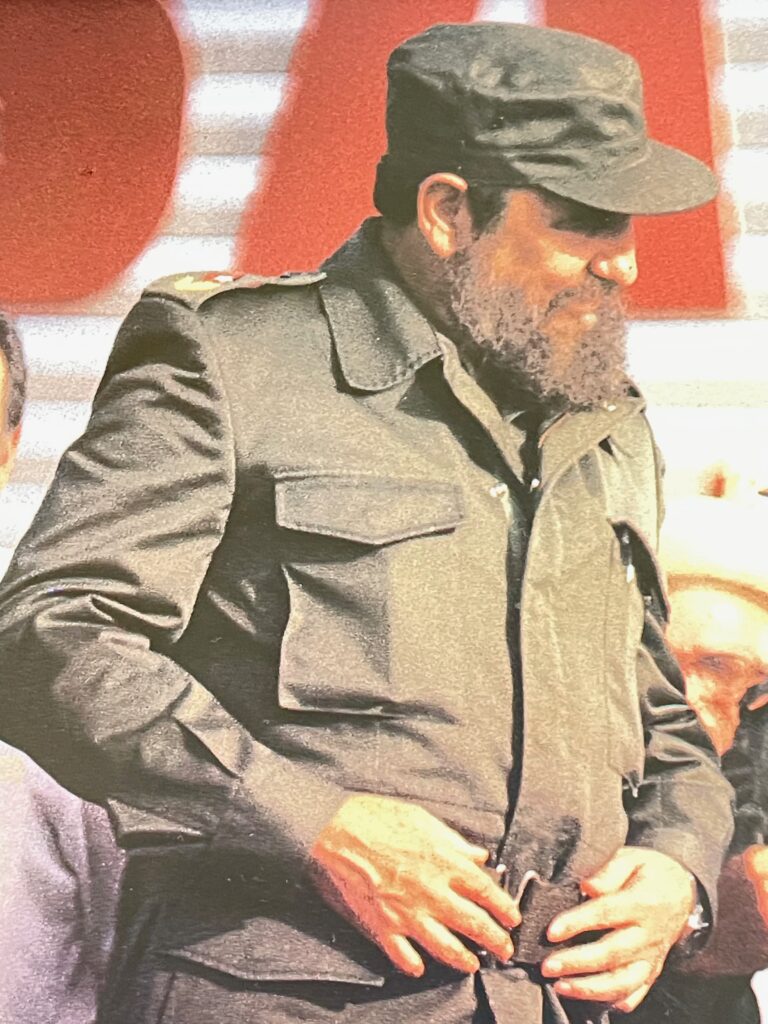
The social experiment in Cuba certainly decreased poverty, attained a degree of sexual and racial equality as well as providing free health and education. The literacy rates were even higher than the USA and Cuba has become renowned for its medicine. But at the same time there were restrictions on the freedom of expression and assembly, including any sexual preferences.
With Castro’s authoritarian leadership the Cuban Communist Party became a dictatorship, a kind of red fascism. Anarchists, who had formed an important movement earlier in the 20th century and who participated in the Revolution were suppressed along with liberals and capitalists alike.
Meanwhile, J. F. Kennedy imposed an economic blockade on the island, hating the idea of a socialist revolution in the Caribbean in America’s so – called ‘backyard’. When the Soviet Union put missiles in Cuba in 1962, Kennedy went to bed ordering a nuclear attack if the missiles were not gone by the morning. Fortunately, Khrushchev blinked first and removed the missiles, saying that it was not worth a nuclear war in which humanity would only be the biggest loser.
Today in 2026 the Cuban Communist Party is still in power. Fidel Castro has died and his brother Raúl is in retirement but has an American arrest warrant hanging over him.
With the collapse of the Soviet Union, the Cubans turned to Venezuela to supply oil at a cheap rate. But after Trump ordered an invasion of this South American socialist country, and abducted its leader Maduro, he imposed an even harsher economic blockade in Cuba – this despite or perhaps because of Obama’s loosening of mutual relations. Cuba is now on its knees and has little room to manoeuvre.
With Marco Rubio as Secretary of State and acting security adviser as well as the son of Cuban exiles in Florida, Cuba seems next on the list to be throttled and attacked. The USA already has the military base of Guantánamo on Cuban soil where it has imprisoned and tortured Islamic militants without formal charges or judicial trial.
I hope this unique experiment in the Caribbean with its considerable equality can survive, yet with greater freedom of expression and action as well as allowing different attitudes and lifestyles to flourish. But the prospect is not looking good.
Peter Marshall is a philosopher, historian, biographer, travel writer and poet. He has written eighteen highly acclaimed books which are being translated into fourteen different languages. His circumnavigation of Africa was made into a 6-part TV series and his voyage around Ireland into a BBC Radio series. He has written articles and reviews for many national newspapers and journals.